Rupture: the
human advantage
Every organisation now has the same AI, the same data, and the same ideas. What is left that cannot be copied — and why it is the only advantage that lasts.
In the middle of May, on the second day of a major AI conference in London, the champagne arrived earlier than usual. Two days in, fourteen sessions had followed the same arc — remarkable demonstrations of what AI can do, smooth transitions from problem to solution, a tone of forward momentum so relentless it was almost impossible to argue with. A VP sitting beside me leaned over and asked the question that had been forming in the room since the opening keynote. If AI is doing all of this, she said, what will happen to us?
The presenter gave the answer that always gets given. Humans plus AI. Complementary strengths. Better together. Nobody challenged it, not because it satisfied them, but because nobody had anything sharper ready. That evening I asked ten people the same question over drinks. Every one of them reached for the same four words — creativity, empathy, judgement, intuition. All true. All useless. These are outputs, not mechanisms. They describe what we want from humans without explaining where it comes from, why it still matters, or what any organisation is supposed to do with the insight on Monday morning.
This essay is an attempt at something more useful than that.
All true. All useless. These are outputs, not mechanisms.
Before we get to what makes humans genuinely irreplaceable, we need to be precise about what we mean by competitive advantage — and why the current answer is failing. To do that, I want to start with something that is easy to miss when you are surrounded by new technology: we are not dealing with a new problem. We are dealing with an old one we have forgotten how to think about.
On my shelf sits a copy of Disruption — Overturning Conventions and Shaking Up the Marketplace, written by Jean-Marie Dru in 1996. The opening line reads: "Disruption? It's nothing new. Just look at any of the breakthrough business ideas of the last thirty years and you will see perfect examples of the principle of disruption in action." Dru's argument was simple and correct: winning is not about doing something better than your competitors within the existing model. It is about finding a new basis for advantage altogether — questioning what has been done and seen before, rejecting the conventional in favour of something that changes the terms of competition entirely.
That was thirty years ago. And somewhere in the intervening decades, with the arrival of data at scale, digital platforms, and now AI, we appear to have developed a collective amnesia about it.
The book makes a second observation that has aged even better. There are limits to being customer-led, Dru wrote. It is a misguided notion that understanding the customer intimately is the secret to success — because the customer cannot imagine the future any better than anyone else. Organisations have the capacity to lead the customer, to shape markets in ways that no dataset would ever recommend, to build futures that the research of today cannot see. We have always known this. We have simply stopped acting on it.
What replaced it is an optimisation-first mindset that conflates cost saving with value creation. Better processes, better data, better tools, smarter allocation of resources, faster iteration. Find what works and do more of it. Organisations pursuing this path are doing something real — AI-driven decision making, process automation and the steady replacement of human effort with machine effort will produce genuine efficiency gains. The mistake is in believing that efficiency gains are the same thing as competitive advantage.
For the vast majority of businesses in established markets, this distinction has already started to matter. Margins are under pressure. Activity has increased but the returns on it have not kept pace. The teams are busier. The tools are more sophisticated. And the gap between the organisations at the top of the market and those chasing them is, if anything, widening rather than closing. This is not a failure of execution. It is a structural consequence of everyone executing the same strategy at the same time.
When multiple organisations have access to the same AI tools, the same market data, and the same competitive intelligence, they converge. Their strategies begin to resemble each other. Their products start to feel interchangeable. Their customer targeting aligns on the same segments, with the same messages, because the same data is pointing them in the same direction. The problem is not noise. The problem is sameness. Markets in this condition don't have a noise problem — they have a variability problem, and more optimisation makes it worse.
What has been substituted, in most organisations, is the how for the what. Better tool use — data, automation, AI — has become the strategy itself, rather than the means of executing one. The implicit assumption is that superior operational capability will determine which brands dominate tomorrow. It won't. It will determine which brands survive long enough to be disrupted by the ones that changed the question.
Clayton Christensen identified the mechanism in The Innovator's Dilemma. Companies that perfect their performance within the existing model become increasingly blind to shifts in the model itself — not because they are incompetent, but because they are exceptionally competent. They have built everything around the current frame. But Christensen was writing before the tools of optimisation became near-infinite. Today, AI can do in minutes what once took months. The capacity to extract performance from an existing model has never been greater — which means the ceiling you are pressing against has never arrived sooner.
This is where most organisations find themselves. And the people profiting most from this environment are the ones selling increasingly sophisticated ways to optimise within it — the AI platform vendors, the automation specialists, the efficiency consultants. They are not wrong to exist. What they provide is genuinely valuable. But there is something they will never tell you: optimisation has a ceiling, and above that ceiling the game changes entirely. The question is what produces the step to a new game. That question is what this essay is really about.
It is 20 October 1968 in Mexico City, and a skinny 21-year-old civil engineering student from Portland, Oregon is about to make the whole world wonder whether it has been doing something wrong.
The setting is the Olympic Games. The event is the high jump. The dominant technique was the straddle — athletes would run toward the bar, plant their foot close to it, rotate their body face down, and clear the bar one leg at a time. It was highly technical, exacting in its demands, and had been accepted as the state of the art for years. Coaches had refined it across generations. Athletes had trained obsessively within its logic. Records rose through steady, incremental gains as each cohort applied themselves more completely to the method. Progress was real and consistent. Then it slowed.
Dick Fosbury's career had given no indication of what was coming. At sixteen he had settled on the high jump, but nothing about his performances suggested future dominance. He was doing what every young athlete is taught to do: practise the accepted technique, improve through repetition, optimise performance within the established model. The feedback was unambiguous and not kind. He was not improving. He lacked the physical attributes and technical precision the straddle demanded, and he failed to qualify for multiple high-school meets because he could not clear the relatively modest height of 1.52 metres. The gap between him and the leading athletes of his age was large enough that closing it through better execution of the existing technique would have been a wasted effort. In a world governed purely by optimisation, this is where the story would have ended. The system had delivered its verdict. Future Olympic gold medallist Dick Fosbury, it turned out, was not very good at high jump.
But the story didn't end there.
What happened next was not a flash of genius. It was something slower and less romantic. Dick began to experiment — not with a fully formed theory, but with an instinct that something about the geometry of the jump could be different. He had played as a teenager with an unusual movement, twisting his body in a way that felt more natural, less contorted. He returned to it not because it seemed promising but because nothing else was working. Early attempts were ungainly. A local newspaper labelled him the World's Laziest High Jumper, which gives some sense of how it looked to observers.
Alongside the instinct, something more analytical was developing. The engineering mind engaged with the problem. He considered centre of gravity — the relationship between the position of his mass and the position of the bar. By arching his back and curving his body as he cleared the height, he realised that his centre of mass could pass below the bar while his body cleared it. In theoretical terms this offered a genuine advantage. In practical terms it looked, as early commentators generously put it, like a man having a very public disagreement with gravity.
Still he persisted.
The argument ended early in his second year of college, when he cleared 2.08 metres in his first meet of the season and demolished the existing school record. The conversation about whether the technique was legitimate stopped almost overnight. His coach, who had spent months trying to pull him back toward orthodoxy, began filming the jump, studying it, even teaching it to younger athletes. The same movement that had attracted ridicule now demanded serious analysis. National coverage followed. Fosbury appeared on the cover of Track and Field News. He won the NCAA title and then the Olympic trials.
Which is how he arrived in Mexico City — not as a curiosity, but as a genuine contender. When the bar was raised and the world watched, the technique that had been called awkward, inefficient and absurd carried him over it at 2.24 metres and into Olympic gold.
He did not simply win. He replaced the old model in real time. Within a decade the straddle had essentially disappeared from the event. Today no serious high jumper uses it.
He didn't find a better version of the existing technique. He made it irrelevant.
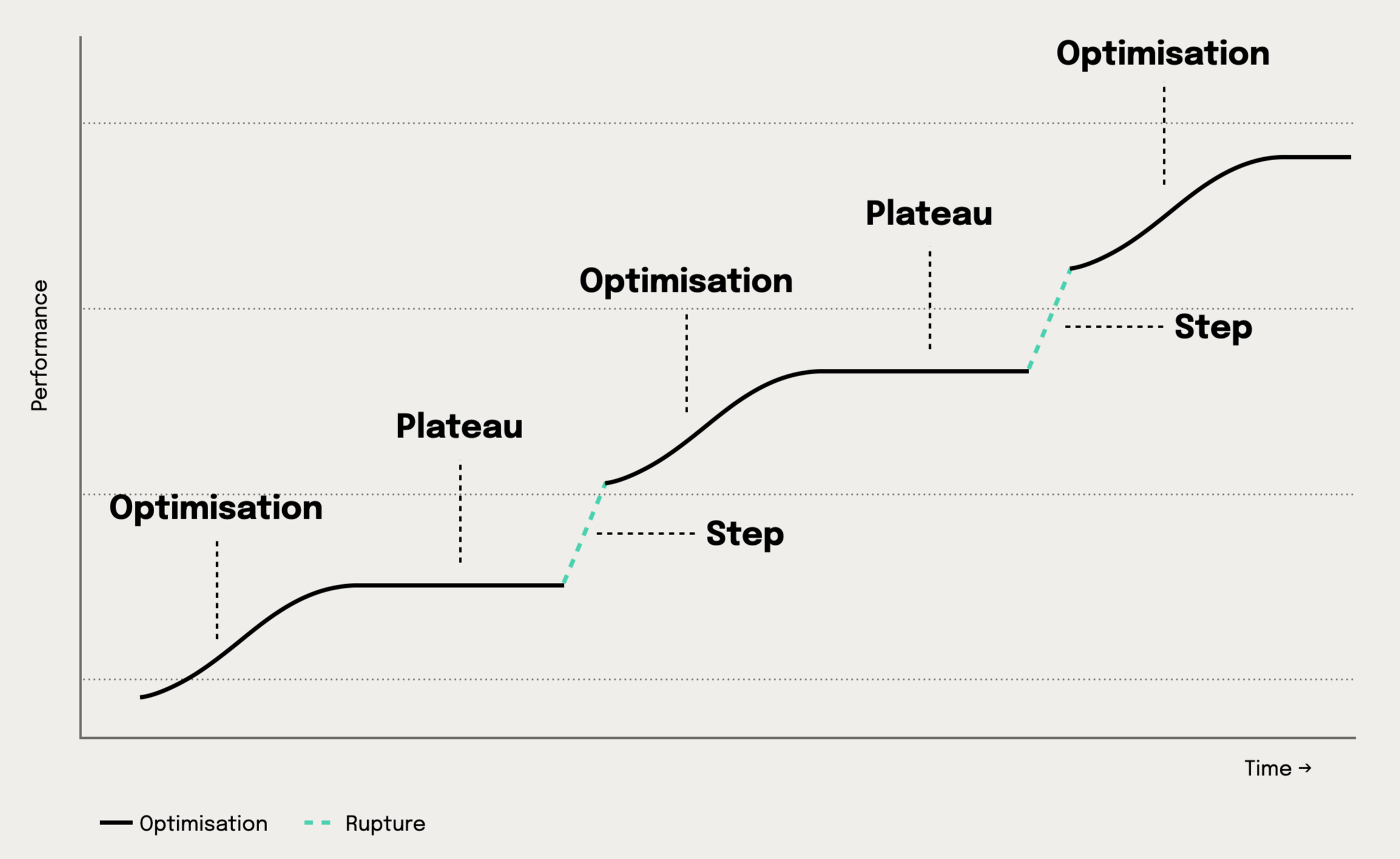
This was not the first time the high jump had been rebuilt. The scissors gave way to the Western Roll, which gave way to the straddle. Each new method changed the shape of the jump, produced a rapid rise in performance, and was then refined and optimised until the gains slowed and each additional centimetre demanded disproportionate effort. The history of the event is not a smooth upward curve. It is a staircase — steep when a new method arrives, flattening as the method is pushed toward its limits, then a vertical step when someone abandons it entirely and creates a new one.
Thomas Kuhn noticed the same pattern in science. In The Structure of Scientific Revolutions he described how long periods of normal science accumulate refinements of the dominant theory — making predictions more precise, building careers on mastery of the existing model — until anomalies begin to pile up. Observations the theory cannot explain are first dismissed, then acknowledged, and finally, under sufficient pressure, used to displace the old model entirely. The step is not built on what came before. It replaces what came before.
Joseph Schumpeter saw it in economics. Capitalism, he argued, does not advance in a smooth upward line. It advances through waves of creative destruction — moments when new technologies or models don't improve the existing market but make it irrelevant. The steam engine did not build a better horse. The digital platform did not build a better catalogue. Progress is not accumulation. It is replacement. Long stretches of optimisation give way to moments where the ceiling of one world becomes the floor of the next.
And Christensen, as we have already seen, found the same logic at work in business: companies so competent within the current frame that they stop questioning whether the frame is right.
The pattern is consistent enough across every domain to deserve a name. I call it the Progress Staircase. Progress within a model is a climb. Progress between models is a step. The steps are what move the ceiling. Optimisation fills the gaps between them. It has never been the source of the steps themselves.
Progress within a model is a climb. Progress between models is a step.
Now we arrive at the question London couldn't answer. What produces the steps?
In every case — science, sport, economics, business — the step is produced when someone changes one of three things. They change what is true, by pursuing an anomaly that everyone else dismissed, or by choosing to challenge an assumption that nobody had thought to test. They change what matters, by identifying that the objective everyone was optimising toward had been defined by the wrong people, or wasn't what the market actually valued. Or they change what is possible, by refusing to accept a constraint that turns out to be a convention rather than a rule.
You only need to change one of those three things. That is enough to redefine the game.
Alexander Fleming returned from holiday in September 1928 to find a petri dish contaminated with mould. The mould was killing the bacteria around it. Most researchers would have thrown the dish away and started again — the result was noise, not signal, an experiment gone wrong. Fleming asked why. What he pursued in that contaminated dish eventually became penicillin. Estimates of lives saved by what followed exceed 500 million. He didn't improve the existing approach to infection. He changed what was true — not by following the model, but by refusing to discard what the model said was an error.
Roger Bannister ran the mile in 3 minutes 59.4 seconds on 6 May 1954. Before that afternoon, the sub-four-minute mile was widely considered physiologically impossible. Coaches said it, sports scientists said it, and the fact that nobody had done it seemed to confirm it. Within 46 days, John Landy broke Bannister's record. Within three years, several athletes had gone sub-four. The constraint had been conceptual, not physical. Bannister didn't find a new running technique. He changed what was possible — by deciding not to believe a ceiling that turned out to be a convention wearing the clothes of a fact.
This is what I mean by Rupture. Not disruption, which competes on price or convenience within shared assumptions. Not transformation, which implies a managed reorganisation of what already exists. Rupture is the moment humans redefine what is true, what matters, or what is possible — and change the basis of advantage entirely. The distinction matters because the mechanism is different, the skill required is different, and the source of the capability is different.
Rupture is the moment humans redefine what is true, what matters, or what is possible — and change the basis of advantage entirely.
Here is where the argument about AI becomes precise.
AI is extraordinary. It is the most powerful optimisation engine ever created. It can find patterns in datasets too large for any human to process, predict outcomes with a precision that exceeds the best human forecasters in structured domains, and model the three-dimensional structure of proteins that took structural biology decades to approach. AlphaGo's Move 37 in the 2016 match against Lee Sedol was described by world-class players as a move no human would have made — creative, surprising, and correct. AlphaFold gave biology something it had been chasing for fifty years. These are not small achievements. They are genuinely remarkable.
But they all happened inside a frame.
AlphaGo's Move 37 existed within the formal rules of Go — a system defined by a board, two colours, and a fixed set of legal moves. AlphaFold operated within structural biology as currently understood. Neither system decided its frame was wrong, or that a different question might be worth asking. AlphaFold did not conclude that protein folding was the wrong level of analysis. AlphaGo did not decide that winning at Go had failed to capture what was actually interesting about the game. These are not criticisms. They are simply descriptions of what the technology is.
AI has a frame. Its training data defines what is true. Its objective function defines what matters. Its constraints define what is possible. Within that frame it achieves things of genuine wonder. The frame itself does not move.
The human frame is constitutively different. It is always moving.
We exist in the world and we care about what happens in it. That combination — existence and care — means our frame cannot remain fixed. We encounter reality directly: unfiltered, embodied, full of signals nobody deliberately collected. We move through spaces, have conversations, notice things that feel wrong without being able to say exactly why. Eight billion people, each exploring different corners of the same world, each building a model of what is true, what matters, and what is possible that is being continuously updated by direct contact with a reality that was never optimised for any objective function.
Fleming was in the right place to notice the mould because he was there — physically present, in a specific laboratory, at a specific moment, with a specific set of prior experience that told him what he was looking at was unusual. No AI trained on the existing bacteriology literature would have flagged the contaminated dish as the important result. There was no ground truth to train on. The discovery preceded the understanding, and the understanding was reverse-engineered from the discovery afterwards. This is one of the most consistent patterns in the history of Rupture. What is possible is often discovered empirically — through action in the world, before the explanation exists to justify the action.
The asymmetry here is not an argument against AI. In every domain where a frame has been changed by a human, AI becomes a powerful ally in filling in what the new frame makes possible. Once Fleming established that mould could kill bacteria, the subsequent work of identifying the mechanism, synthesising the compound, and scaling production would, in a modern context, be massively accelerated by AI. The human changes the frame. AI helps fill in the territory the new frame reveals. These are not competing roles. They are sequential ones.
But the sequence matters. AI can only explore a frame it has been given. It cannot arrive at a new one.
AI can only explore a frame it has been given. It cannot arrive at a new one.
Which brings us back to the four words from London — and to why they are true but insufficient.
They are insufficient because they describe what humans do at the surface, not what makes them able to do it. The deeper answer has to do with something the philosopher Michael Polanyi called the tacit dimension of human knowledge. We know more than we can tell, he wrote. The surgeon knows something in their hands that they cannot fully put into words. The experienced investor makes judgements that turn out to be right but cannot be reduced to a rule set. The jazz musician hears where the next note wants to go in a way that is faster and more accurate than any explicit calculus could be. These forms of knowing are built from accumulation — from long immersion in a domain, from thousands of hours of direct contact with reality, from a kind of absorbed intelligence that operates faster than conscious reasoning. They cannot be optimised into a model because the tacit dimension does not reduce to explicit rules. That is precisely what defines it.
Cliff Young was 61 years old when he entered the 1983 Sydney to Melbourne ultramarathon. He was wearing overalls and gumboots. He had never competed in a serious race. Most of the professional athletes assumed he was a spectator who had wandered into the wrong area. The race covered 875 kilometres. What Young had, and the other runners lacked, was fifty years of experience mustering sheep across large paddocks in difficult conditions — sometimes for days without proper sleep. The professional runners trained on interval technique: run for 18 hours, sleep for six. Young had simply never been taught that this was how it was done. He shuffled continuously through the nights while the trained competitors rested, operating on the tacit knowledge of a working life nobody had thought to study. He won by nearly two days and broke the course record. What became known as the Young Shuffle is now standard practice in ultramarathon. His embodied knowledge — accumulated, untranslatable, invisible to any training dataset — was the decisive advantage.
This is the kind of capability that produces Rupture. Not intelligence in the abstract. Not creativity as a personality trait. But the specific, accumulated, embodied knowledge that comes from being a particular person who has lived in a particular way, and who carries that knowledge into a context where it changes what everyone else thought was fixed.
There is something else worth saying here — something that does not appear in the management literature, but that anyone who has watched Rupture happen up close will recognise. It requires belief before the evidence arrives.
Fosbury looked ridiculous for years before he cleared 2.08 metres and the conversation changed overnight. Fleming was pursuing a contaminated petri dish that everyone around him would have discarded. Bannister was training for something his peers said was physiologically impossible. In every case, personal conviction carried the work through the period when scepticism was the rational response. This is not irrational stubbornness. It is the specific form of courage required to act without proof in the direction you believe is right. And it is something AI cannot experience, because it has no stake in the outcome and no capacity to feel that a direction is worth pursuing before the data confirms it.
We know more than we can tell.Michael Polanyi
This matters more in business today than at any previous point in recent history.
We are living through the most powerful era of optimisation tooling in history. The ability to analyse, automate and improve performance within an existing model has never been greater. For many organisations, the early returns have been real. AI has cut costs, improved speed, and increased accuracy in well-defined tasks. The business case was easy to make and the results, initially, supported it.
But early returns are not lasting returns. When every competitor has access to the same tools, the same data, and the same models, the advantage those tools provide regresses to zero. Optimisation that was once a differentiator becomes a baseline — the cost of being in the game, not the source of winning it. A more efficiently converged market is still a converged market.
The organisations that will define the next decade are not the ones that optimise best within the current frame. They are the ones that change it. And changing frames is not a technical capability. It is a human one.
Aviva changed a frame in insurance. The industry assumption was that young drivers were high risk — and in aggregate, the data confirmed it. What the assumption missed was that the aggregate masked enormous individual variance. Some young drivers are genuinely risky. Others are not, and were paying premiums priced for a category they didn't belong to. Telematics had made it technically possible to measure individual rather than aggregate risk. What Aviva changed was the assumption — the belief that risk could only be assessed at the group level. That question produced a differentiated proposition in a market that had been converging for decades.
Medtronic dissolved a constraint the entire pacemaker industry had accepted as permanent. Pacemakers and MRI scanners were absolutely contraindicated — the magnetic fields posed a genuine risk to implanted devices, and this was a real boundary, not a convention. The industry treated it as fixed. Medtronic asked whether engineering could dissolve it. The first MRI-conditional pacemaker opened access to millions of patients who had been permanently excluded. The Rupture did not come from optimising the existing pacemaker design. It came from refusing to accept the boundary as given — and then doing the engineering to prove it wasn't.
Neither of these was a once-in-a-generation move. Neither required special genius. Both required a specific orientation toward the current model — a willingness to interrogate the frame rather than perform within it. That orientation can be cultivated. It can be built into how organisations work, how they interpret data, how they approach the assumptions everyone stopped questioning. The frame cannot be changed on demand, but organisations can be structured in ways that make noticing the mould more or less likely.
A more efficiently converged market is still a converged market.
I began in London with a question nobody could answer well. I have spent this essay trying to answer it properly.
The advantage of humans in the age of AI is not creativity in the abstract or empathy as a personality trait. It is the constitutive nature of the human frame — the fact that it is always moving, always being reshaped by direct contact with a reality that no system was designed to capture. It is the capacity to notice what doesn't fit, to decide that it matters before the evidence arrives, to refuse a constraint that turns out to be a convention, and to carry knowledge from one context into another in ways that change what everyone else thought was fixed.
Fosbury noticed that landing on your feet was not a rule.
Fleming asked why the mould was killing the bacteria.
Bannister decided the frame was wrong.
None of them required special cognitive architecture. They required a specific orientation toward the current model — a willingness to challenge what was accepted, a capacity to act before the evidence was in, and the determination to persist through the period when they appeared, to most observers, to be wrong.
In a world where every organisation has access to the same tools, the same data, and the same optimisation engines, this orientation is the only reliable source of competitive advantage. It is what AI cannot replicate, because AI operates inside the frame it is given and cannot decide the frame is worth questioning.
Optimisation will always matter. It fills the staircase between the steps. But the steps themselves — the moments that change what is true, what matters, or what is possible — have always come from humans. They always will. We just never needed to say it out loud until now.